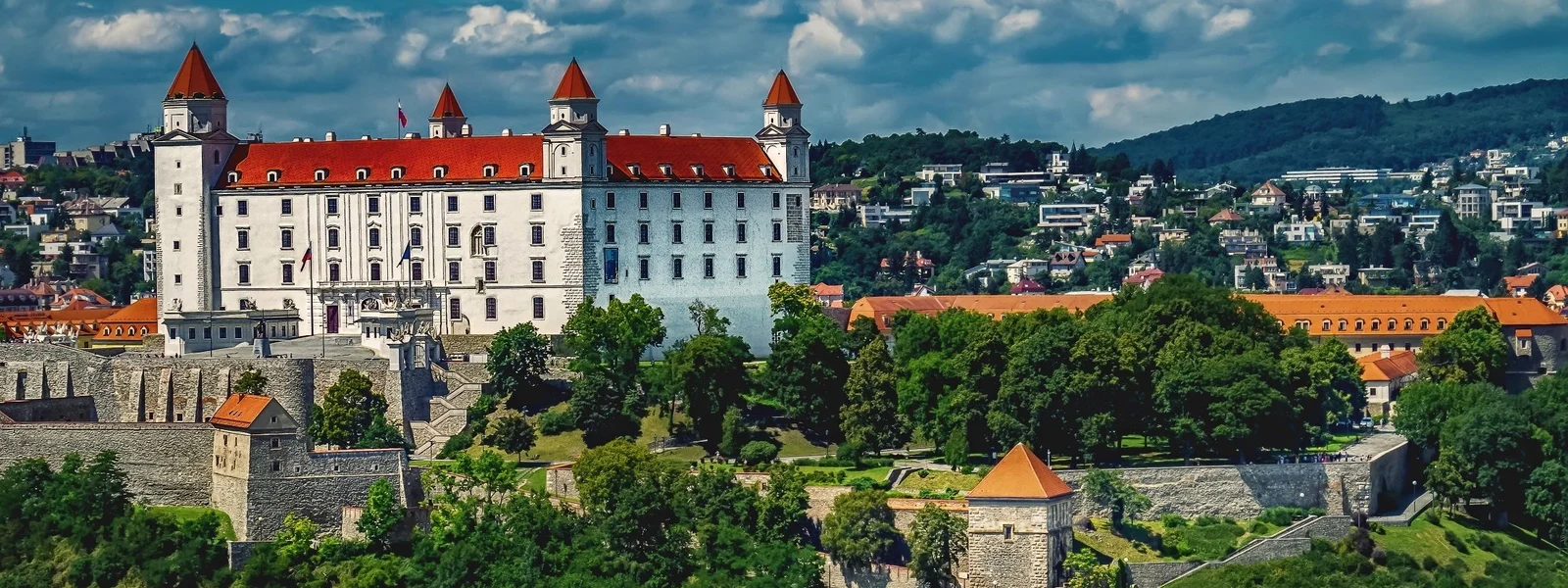
Slovakia eSIM Guide 2026
I have spent real time in Slovakia, and not just the quick stop in Bratislava that many people make on the way between Vienna and Budapest. I have wandered Bratislava's compact old town beneath its castle, then headed east into the country's mountainous heart, hiking the dramatic peaks of the High Tatras above the resort town of Strbske Pleso, exploring the medieval mining towns and wooden churches, descending into the ice caves, and reaching the eastern city of Kosice with its grand gothic cathedral. I have driven the winding roads through the forested valleys, ridden the trains up into the mountains, and used Slovak networks from a mountain hut below the Tatra peaks, from a guesthouse in a valley village, from a rental car on a country road, and from a cafe in Bratislava. That is the perspective behind this guide. Slovakia is a small, mountainous country at the heart of central Europe, often overlooked between its better known neighbors, with a dramatic landscape of high peaks and deep forests and the region's familiar strong, cheap mobile networks. Here is the honest version. Slovakia is a member of the European Union and uses the euro, which keeps things simple. It has three strong mobile networks, Orange, Telekom and O2, and they blanket the country with fast, reliable data that reaches well into the valleys, the towns and the mountain resorts. Coverage is genuinely good across the populated country, with the main gaps tied to the high mountain terrain rather than to any weakness in the networks. The decisions that actually matter are how much data to buy, whether a travel eSIM beats a local SIM for your trip, and how the EU carrier terms rule applies to you. No guide that hands you a single best eSIM and walks away is being straight with you, because the right answer depends on where you come from and how you travel. This hub gives you the full picture, and the eleven satellite articles linked here go deep on each piece, from sizing your data to staying connected in the High Tatras. One particular Slovak angle worth flagging up front: Slovakia sits at the heart of central Europe, sharing a border and even a tram corridor with Vienna, and bordering Hungary, Czechia, Poland and Ukraine, so many travelers visit it as one leg of a wider regional trip, and the regional considerations that follow take that into account. Read this page first, then dive into whichever satellite matches your question. By the end you will know exactly what to buy and what to ignore, and you will not overpay for connectivity that Slovakia, like much of central Europe, keeps fast and cheap and easy.
Why Slovakia is an easy place to stay online
Slovakia rewards travelers who do very little, in keeping with central Europe. The three main networks, Orange, Telekom and O2, blanket the country with fast mobile data that reaches well into small towns, the valleys and the mountain resorts. In Bratislava, the compact capital, and the eastern city of Kosice, you get genuinely quick speeds, and even in smaller places like Zilina, Banska Bystrica, Poprad near the Tatras, or Trencin you will not notice a meaningful drop. The gaps that exist are real but largely tied to the high mountains, where the dramatic terrain blocks signal on the peaks and high trails, a pattern familiar from any mountainous country, rather than to any weakness in the networks themselves. For the overwhelming majority of trips, the question is not whether you will have signal but how much data you want to pay for. The honest framing is that Slovakia is cheap. Mobile data here costs a fraction of what travelers from the United States or the United Kingdom expect, in line with the broader central European pattern, and the travel eSIM market reflects that. You can pick up a generous bundle for very little, which changes the calculation. When data is this affordable, the smart move is to buy a bit more than you think you need rather than counting megabytes. The rest of this guide, and the satellites it links to, is about getting that one decision right, along with a few smaller ones, including how to handle the mountains.
The EU carrier terms rule and who it helps
Slovakia sits inside the European Union and uses the euro, so the carrier rules applies in full and life is simple. If you already carry a SIM or eSIM from another EU country, you can use your home allowance in Slovakia under the carrier terms, with no caps that matter for a normal trip. That is genuinely the cheapest option for EU residents, and if you have an Austrian, Czech, Hungarian, Polish or other EU plan, you can often just switch your phone on and forget about it, which is especially convenient given how many travelers arrive from neighboring Vienna, just across the border, or from Prague, Budapest or Krakow, their EU plan simply continuing to work as they cross. The roaming versus eSIM satellite covers the details, including the fair use limits that only bite on very long stays. The story is completely different for everyone else. If you are coming from the United States, Canada, Australia, the Gulf, most of Asia, or the United Kingdom after Brexit reintroduced roaming fees, your home plan will either charge punishing daily rates or quietly drain your bill. For those travelers a travel eSIM is the obvious cheap choice, turning a potential bill of tens or hundreds of dollars into a few dollars. The dividing line is simple: EU plan, use their home plan; everyone else, buy an eSIM.
How much data you actually need
Most travelers misjudge their data needs, and both overestimating and underestimating cost money in Slovakia. The how much data satellite has the full breakdown, but the short version is this. Maps, messaging, mobile payments and the occasional photo upload sip data, and a light user can get through a week on a couple of gigabytes. The moment you add streaming video, heavy social scrolling, or frequent video calls home, the number climbs fast. A few hours of video a day can burn a gigabyte before lunch. For a typical one week trip splitting Bratislava with some time in the Tatras, somewhere around five gigabytes is a comfortable cushion. For two weeks of mixed travel or a wider central European trip, ten to fifteen gigabytes is sensible. Because Slovak data is cheap, the cost difference between a tight bundle and a generous one is small, so I lean toward buying more. Running out and scrambling to top up through a foreign app store is more annoying than the dollar or two you save by cutting it fine, especially when the savings here are so small to begin with. One Slovakia specific note: you will spend hours offline on the high mountain trails regardless, which naturally tempers your usage.
eSIM versus a local Slovak SIM
For a non EU traveler, you have two real options: a travel eSIM bought before you arrive, or a local prepaid SIM from a Slovak network bought once you land. Both work well on the same networks, and the eSIM versus local SIM satellite compares them in detail. The travel eSIM wins on convenience by a wide margin. You buy it from your sofa, install it before the flight, and step off the plane in Bratislava already online, with no kiosk hunting, no paperwork, and no language barrier at a counter, though Slovaks in the tourism trade generally speak good English. The local SIM can win on raw value for a long stay with a large allowance, because Slovak prepaid plans are cheap and often include generous data. The trade off is the small hassle of buying and activating one. For a trip of a week or two, the eSIM is almost always the better call. For a month or more as a base, the local SIM starts to make sense, which the digital nomad satellite explores. For most short trips, especially as part of a central European itinerary, the eSIM or a regional plan is the smoother choice, and for mountain trips a network with good Tatra coverage matters more than the eSIM versus SIM question.
Choosing a network for the mountains
Slovakia has three networks that own real infrastructure: Orange, Telekom, formerly the state operator with strong coverage, and O2, the popular challenger. Everything else you see, the various low cost brands, runs on top of one of these. The operators satellite maps out who runs on what, but for a traveler the practical point is that all three main networks give strong coverage across the populated country, including the valleys and the mountain resort towns, so for city and valley travel you rarely need to obsess over which one your eSIM uses. Where it matters more in Slovakia than in flatter countries is the mountains: in the High Tatras and the other ranges, the dramatic terrain means coverage follows the valleys and the resort towns and fades on the high peaks and trails, and a travel eSIM that rides a network with good mountain reach, Telekom having a strong reputation, or that roams across several to grab the strongest signal, gives you the best odds in the marginal mountain areas. You do not need to obsess over this for a Bratislava trip, but for serious hiking in the Tatras, the network and the offline preparation both matter.
Mono country plan or regional Europe plan
If Slovakia is your only stop, a Slovakia specific eSIM is the cheapest and simplest choice. But Slovakia sits at the heart of central Europe, exceptionally well placed for a regional trip. Bratislava is astonishingly close to Vienna, just across the border with a direct connection, and the country borders Czechia, Hungary and Poland too, so many travelers visit Slovakia as one leg of a central European tour linking Vienna, Bratislava, Budapest, Prague and Krakow. For those itineraries, a regional Europe eSIM covering Slovakia and its neighbors, and indeed thirty nine or more countries, on a single plan is the smarter buy, because you keep one number and one allowance across the borders without juggling separate purchases. The trade off is that regional plans cost a little more per gigabyte than a tight mono country bundle. The rule of thumb: Slovakia only, buy mono; a central European tour or a wider trip, go regional. Slovakia is covered by every major regional Europe plan, so going wide costs nothing in coverage. Given how often Slovakia, and especially Bratislava, is one stop on a larger regional journey, the regional plan suits a good share of visitors. The best eSIM satellite digs into this, and the regional satellites cover Bratislava with the west, and the High Tatras.
What to do next
If you take only one thing from this hub, take this: Slovakia, like much of central Europe, makes connectivity cheap and easy, so do not overthink it, but do get the basics right, with a little extra care for the mountains. Decide whether you fall on the EU carrier terms side of the line or the buy an eSIM side. Size your data with a little headroom, because the savings from rationing are tiny here. Pick a travel eSIM that rides the big three networks, which between them cover the populated country and the valleys well, choosing one with good mountain reach like Telekom or a multi network plan if you are heading into the Tatras. Choose a regional plan if Slovakia is one leg of a central European tour, which it very often is given Bratislava's position next to Vienna. From there, the eleven satellites linked on this page take each decision deeper. The setup guide walks you through installation, the coverage satellite shows you the mountain gaps, the data satellite turns activities into gigabytes, and the regional satellites cover Bratislava plus the High Tatras. Start with whichever question is nagging you most, and you will have a connectivity plan dialed in within a few minutes. Slovakia is an underrated, well connected country to travel through with a phone in your pocket, home to a charming capital and some of the most dramatic mountains in central Europe, and getting online should be the least of your worries, even if the high peaks will, by their nature, occasionally take you offline.
Buyer guide
Comparison
Coverage
Operators
Data planning
How-to
Apps
Use case
Region
Bratislava and Western Slovakia eSIM
Bratislava sits right next to Vienna, fully covered and easy to stay online in. Here is how connectivity works in the capital and across western Slovakia.
Read the guide →🗺️RegionHigh Tatras eSIM
The High Tatras are Slovakia's dramatic alpine range, with coverage in the valleys and resorts but not on the peaks. Here is how to stay connected hiking.
Read the guide →Networks available by plan
The network depends on the plan you choose. These are the published operators for the first six plans currently sold.
| Plan | Published operators |
|---|---|
| 1 GB · 7 days | Orange Slovensko, O2 Slovakia |
| 3 GB · 15 days | Orange Slovensko, O2 Slovakia |
| 5 GB · 30 days | Orange Slovensko, O2 Slovakia |
| 10 GB · 30 days | Orange Slovensko, O2 Slovakia |
| 20 GB · 30 days | Orange Slovensko, O2 Slovakia |
Slovakia eSIM FAQ
What coverage and network performance should travelers expect in Slovakia?
Slovakia has three networks that own real infrastructure: Orange, Telekom, formerly the state operator with strong coverage, and O2, the popular challenger. Everything else you see, the various low cost brands, runs on top of one of these. The operators satellite maps out who runs on what, but for a traveler the practical point is that all three main networks give strong coverage across the populated country, including the valleys and the mountain resort towns, so for city and valley travel you rarely need to obsess over which one your eSIM uses.
Is a travel eSIM better than local SIM or roaming in Slovakia?
Slovakia sits inside the European Union and uses the euro, so the carrier rules applies in full and life is simple. If you already carry a SIM or eSIM from another EU country, you can use your home allowance in Slovakia under the carrier terms, with no caps that matter for a normal trip. That is genuinely the cheapest option for EU residents, and if you have an Austrian, Czech, Hungarian, Polish or other EU plan, you can often just switch your phone on and forget about it, which is especially convenient given how many travelers arrive from neighboring Vienna, just across the border, or from Prague, Budapest or Krakow, their EU plan simply continuing to work as they cross.
How much data you actually need?
Most travelers misjudge their data needs, and both overestimating and underestimating cost money in Slovakia. The how much data satellite has the full breakdown, but the short version is this. Maps, messaging, mobile payments and the occasional photo upload sip data, and a light user can get through a week on a couple of gigabytes. The moment you add streaming video, heavy social scrolling, or frequent video calls home, the number climbs fast. A few hours of video a day can burn a gigabyte before lunch. For a typical one week trip splitting Bratislava with some time in the Tatras, somewhere around five gigabytes is a comfortable cushion.
How much data and what kind of plan do travelers need in Slovakia?
If Slovakia is your only stop, a Slovakia specific eSIM is the cheapest and simplest choice. But Slovakia sits at the heart of central Europe, exceptionally well placed for a regional trip. Bratislava is astonishingly close to Vienna, just across the border with a direct connection, and the country borders Czechia, Hungary and Poland too, so many travelers visit Slovakia as one leg of a central European tour linking Vienna, Bratislava, Budapest, Prague and Krakow.
Sort your Slovakia eSIM
Pick the plan that fits your trip, or work out how much data you need first.