Bratislava and Western Slovakia eSIM: The Capital by Vienna
Why Bratislava and the west are their own connectivity story
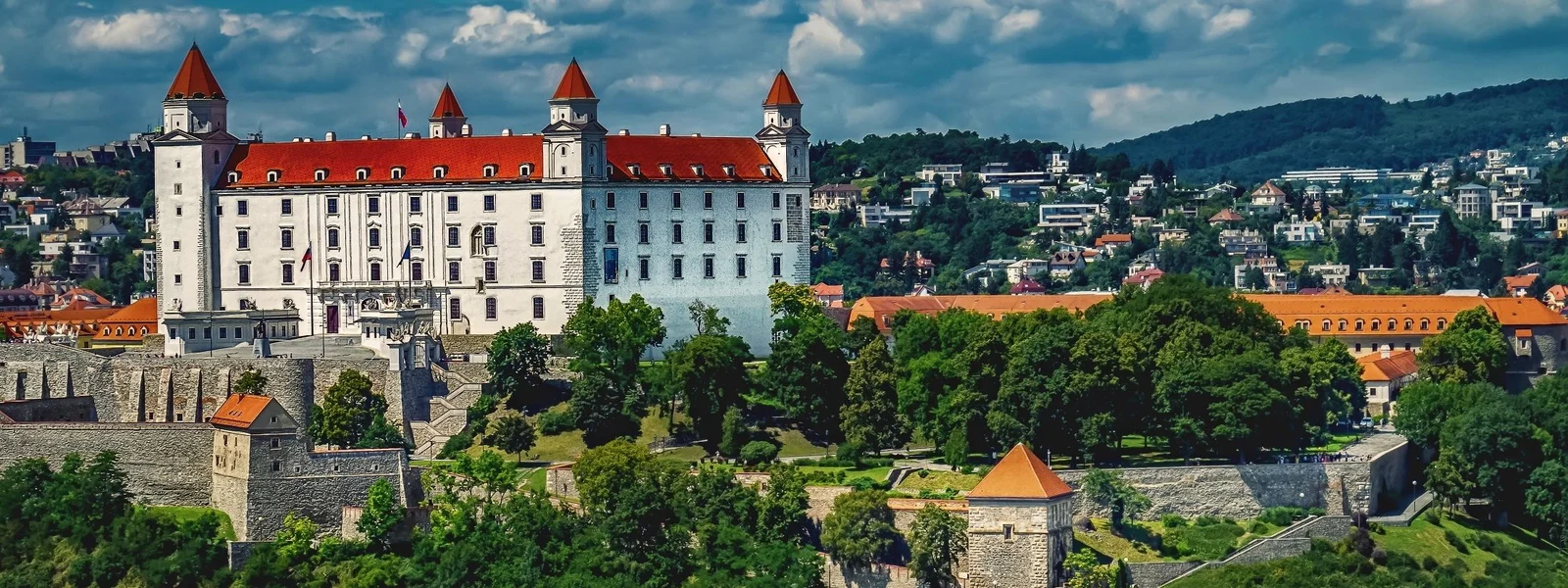
Bratislava is the capital of Slovakia and one of the most unusually located capitals in Europe, sitting right on the Austrian border, barely an hour from Vienna, close to Hungary too, at the meeting point of central Europe. It is a compact, walkable city with a charming old town beneath a hilltop castle, and it is where most visitors spend the bulk of any short Slovak trip, often arriving as a day trip or stop from Vienna. The surrounding western Slovakia, the lowlands and gentle hills near the capital, includes the wine country of the Small Carpathians, historic towns like Trencin with its castle, and the country's most populated and developed region. For connectivity, Bratislava and the west are excellent throughout, the flat and populated heart of the country with strong infrastructure and none of the mountain gaps found further east. Understanding the capital and its region as their own connectivity story helps because for many travelers Bratislava is Slovakia, an easy city break or a stop on a central European tour, fully and effortlessly connected.
Bratislava's old town and castle
In Bratislava's compact old town, with its cobbled lanes, the main square, St Martin's cathedral, and the quirky bronze statues, you have full fast coverage, so you can navigate the streets, share the sights and tap to pay without a thought. The hilltop castle overlooking the city and the Danube, a short climb or walk up, is well covered, so the panoramic views keep you connected. The riverside, the modern districts, the famous UFO bridge with its observation deck, and the residential neighborhoods are all strongly covered with 5G and 4G from every network. Bratislava is a modern, well connected capital, and abundant free wifi in cafes, hotels and public spaces adds to the excellent mobile coverage, so the heart of any Slovak trip is effortlessly connected. The city's position right by the Austrian border means you should just be aware, near the very edge, that your phone stays on a Slovak network rather than picking up an Austrian one, though since both are EU this only matters for tidiness, not cost, as roaming is free across the border either way for EU plans.
Western Slovakia and the wine country
Beyond Bratislava, western Slovakia is the country's flat, populated and well developed heartland, and it is reliably covered throughout. The Small Carpathian wine region, a string of vineyards and wine villages like Pezinok and Modra just north of the capital, is well covered, so a day of wine tasting among the cellars stays online. The historic towns of the west, Trencin with its dramatic clifftop castle, Trnava with its churches, Nitra with its castle hill, are all well covered. The lowlands along the Danube and the Hungarian border, the agricultural plains, and the routes connecting the towns are all reliably connected. This western region, being flat and populated, has none of the coverage challenges of the eastern mountains, so exploring the capital's surroundings, the wine country and the historic western towns keeps you connected throughout, with your phone reliable for navigation and sharing. It is only when you travel east into the mountainous centre and the Tatras that the coverage picture changes.
Getting around and the Vienna connection
Bratislava is a compact, walkable city, and getting around its centre on foot keeps you connected throughout. The city's trams, trolleybuses and buses are all well covered for navigation and ticketing. The remarkable Vienna connection deserves a mention: Bratislava and Vienna are barely an hour apart, linked by frequent trains, buses and even a boat along the Danube, and the whole corridor is well covered on both sides of the border, so a day trip between the two capitals, or arriving in Bratislava from Vienna, keeps you connected the entire way, with EU carrier terms meaning no change in cost as you cross. The routes west and south to the wine country and the historic towns are covered. If you arrive at Bratislava airport or the larger Vienna airport that many use to reach the city, both are well covered and the connections are easy. For a capital that doubles as an easy extension of a Vienna trip, Bratislava could hardly be easier to stay connected in, leaving you free to enjoy the old town, the castle and the relaxed Danube setting.
A smart setup for Bratislava and the west
For a Bratislava and western Slovakia trip, the setup is simple because the region is flat, populated and uniformly well covered. An EU resident roams free; everyone else buys a Slovakia eSIM, and since the capital and the west are well covered by all networks you need not worry about which one, unlike for a mountain trip. Base yourself in or near the old town, and explore the city and its surroundings with confidence that your phone works throughout. If your trip extends east to the High Tatras and the mountains, you will want to think about mountain network reach and offline maps as covered in the Tatras satellite, but for the capital and the west, any good eSIM is fine. If Bratislava is one stop of a central European tour, especially paired with nearby Vienna, a regional eSIM keeps you connected across the borders. A connected itinerary might run a day or two exploring Bratislava's old town and castle, a wine tasting trip into the Small Carpathians, a visit to clifftop Trencin castle, and perhaps a day trip across to Vienna, all on strong signal. As one of Europe's most accessible and underrated capitals, sitting right at the crossroads of central Europe, Bratislava and its western region make an easy and rewarding base, fully connected and perfectly placed for exploring beyond the borders.
A connected break in Bratislava and the west
To see how it fits together, picture a few days in and around Bratislava with connectivity handled, which in this flat, well covered region is effortless. You arrive in Bratislava, perhaps flying in directly or, as many do, coming across from Vienna in barely an hour by train, bus or boat along the Danube, connected the whole way with EU carrier terms meaning no change in cost at the border. You spend your first day exploring the compact old town, navigating the cobbled lanes to the main square, St Martin's cathedral and the quirky bronze statues, then climbing to the hilltop castle for the panoramic view over the Danube and across to Austria and Hungary, all on strong signal. The next day you head into the Small Carpathian wine country just north of the city, touring the cellars and vineyards of Pezinok and Modra, your phone working throughout for navigation between the wineries. You take a trip to dramatic clifftop Trencin castle, or to historic Trnava or Nitra, all well covered. Throughout, a Slovakia eSIM, or simply your roaming EU plan, keeps you connected for the whole trip, and since the western region is flat and uniformly covered you never think about which network. If Bratislava is paired with nearby Vienna or is one stop of a central European tour, a regional eSIM keeps you connected across the borders. Bratislava and western Slovakia make an easy, underrated and well connected break, a charming capital at the crossroads of central Europe with wine country and castles within easy reach, all effortlessly online, a complete contrast to the offline mountain heights waiting in the east of the country.
Why Bratislava and the west reward a connected visit
There is a particular ease to a connected visit to Bratislava and western Slovakia, a region that is flat, populated and uniformly well covered, and embracing how effortless the connectivity is lets you focus entirely on what makes this corner of central Europe special. Bratislava is a place to wander without a thought for your phone working, from the cobbled old town beneath the castle to the riverside, the quirky bronze statues, and the views across the Danube to three countries, with your phone reliable throughout for navigation, sharing and finding the next cafe or wine bar. The remarkable thing about the region is its position at the crossroads of central Europe, with Vienna an hour away, Budapest and Prague within easy reach, and the Hungarian and Austrian borders right at hand, all connected on one plan or EU carrier terms, so the connectivity supports not just a city break but a base for exploring a whole corner of the continent. The mindset that serves you here is simply to relax about connectivity entirely, because in this well covered lowland region it is a non issue, and to pour your attention into the charm of the compact capital, the wine country of the Small Carpathians, the historic castle towns, and the easy access to neighboring countries. Whether Bratislava is your sole destination, an extension of a Vienna trip, or one stop on a central European tour, the western region rewards the connected traveler with an underrated and accessible slice of central Europe, fully online and perfectly placed, a relaxed and well connected counterpart to the dramatic offline mountains that await in the east of the country, and a reminder that Slovakia offers both the effortless connectivity of the lowlands and the wild solitude of the heights within one small, rewarding country.
Plans for Slovakia
Slovakia eSIM plans
Prices in USD. Instant QR activation. Pick your data, land connected.
FAQ
How should travelers set up and activate an eSIM for Slovakia?
For a Bratislava and western Slovakia trip, the setup is simple because the region is flat, populated and uniformly well covered. An EU resident roams free; everyone else buys a Slovakia eSIM, and since the capital and the west are well covered by all networks you need not worry about which one, unlike for a mountain trip. Base yourself in or near the old town, and explore the city and its surroundings with confidence that your phone works throughout. If your trip extends east to the High Tatras and the mountains, you will want to think about mountain network reach and offline maps as covered in the Tatras satellite, but for the capital and the west, any good eSIM is fine.
What is the connectivity picture in Slovakia?
Bratislava is the capital of Slovakia and one of the most unusually located capitals in Europe, sitting right on the Austrian border, barely an hour from Vienna, close to Hungary too, at the meeting point of central Europe. It is a compact, walkable city with a charming old town beneath a hilltop castle, and it is where most visitors spend the bulk of any short Slovak trip, often arriving as a day trip or stop from Vienna. The surrounding western Slovakia, the lowlands and gentle hills near the capital, includes the wine country of the Small Carpathians, historic towns like Trencin with its castle, and the country's most populated and developed region.
What should travelers know about bratislava's old town and castle in Slovakia?
In Bratislava's compact old town, with its cobbled lanes, the main square, St Martin's cathedral, and the quirky bronze statues, you have full fast coverage, so you can navigate the streets, share the sights and tap to pay without a thought. The hilltop castle overlooking the city and the Danube, a short climb or walk up, is well covered, so the panoramic views keep you connected. The riverside, the modern districts, the famous UFO bridge with its observation deck, and the residential neighborhoods are all strongly covered with 5G and 4G from every network.
What should travelers know about western slovakia and the wine country in Slovakia?
Beyond Bratislava, western Slovakia is the country's flat, populated and well developed heartland, and it is reliably covered throughout. The Small Carpathian wine region, a string of vineyards and wine villages like Pezinok and Modra just north of the capital, is well covered, so a day of wine tasting among the cellars stays online. The historic towns of the west, Trencin with its dramatic clifftop castle, Trnava with its churches, Nitra with its castle hill, are all well covered. The lowlands along the Danube and the Hungarian border, the agricultural plains, and the routes connecting the towns are all reliably connected.