Julian Alps and Coast eSIM Guide: Slovenia's Mountains and Sea
Two landscapes, one short drive apart
Slovenia's signature contrast is how close its mountains and its sea sit to one another. In a single day you can stand beneath the peaks of the Julian Alps and then dip your feet in the Adriatic at Piran. This compactness is a joy to travel, but it means your connectivity changes character as you move. The alpine regions reward offline preparation, while the coast behaves like the cities, dense and well covered. Understanding both halves helps you plan a trip that takes in this remarkable variety without connectivity worries.
Coverage in the Julian Alps
The Julian Alps, centred on Triglav National Park, are spectacular and largely well covered on the valley floors and in the resort towns. Bled, Bohinj, Kranjska Gora, and the Soca valley settlements all have solid signal, so your base will be connected. The gaps appear when you climb, on hiking trails, high passes, and back country routes where terrain blocks the signal. This is normal for any mountain region. Treat the valleys as connected and the heights as offline, and prepare accordingly before you set out on any walk.
The Adriatic coast
Slovenia's coastline is short, just a few dozen kilometres, but its towns are gems. Koper, Izola, Piran, and Portoroz all enjoy dense, reliable coverage with fast data, behaving much like the inland cities. The one thing to watch near the coast is that your phone can occasionally try to connect to an Italian or Croatian network when you are right by the border, which for a non-EU eSIM can interrupt your Slovenian plan. Leaving network selection on automatic usually keeps you on the right network without any intervention.
Offline preparation for the mountains
Before heading into the Alps, build the simple habit of downloading offline maps of the area and saving your route, accommodation, and key directions while you still have signal in the valley. If you are hiking in Triglav National Park or driving the dramatic Vrsic pass, download everything in advance. The valley floors will keep you connected most of the time, but the offline backup means a dead zone on a ridge or in a gorge never becomes a problem. A few minutes of preparation transforms the experience of exploring the high country.
Planning data for a mixed trip
A trip combining the Alps and the coast is light on data in absolute terms, because so much of your time is spent outdoors, navigating and taking photos rather than streaming. Offline maps cut the cellular load further. For a week split between the mountains and the sea, three to five gigabytes is comfortable for most travellers, with accommodation wifi covering the heavier tasks. A regional Europe eSIM is especially worth considering here, since the coast sits minutes from both Italy and Croatia and the temptation to cross a border is strong.
Lake Bled and Lake Bohinj
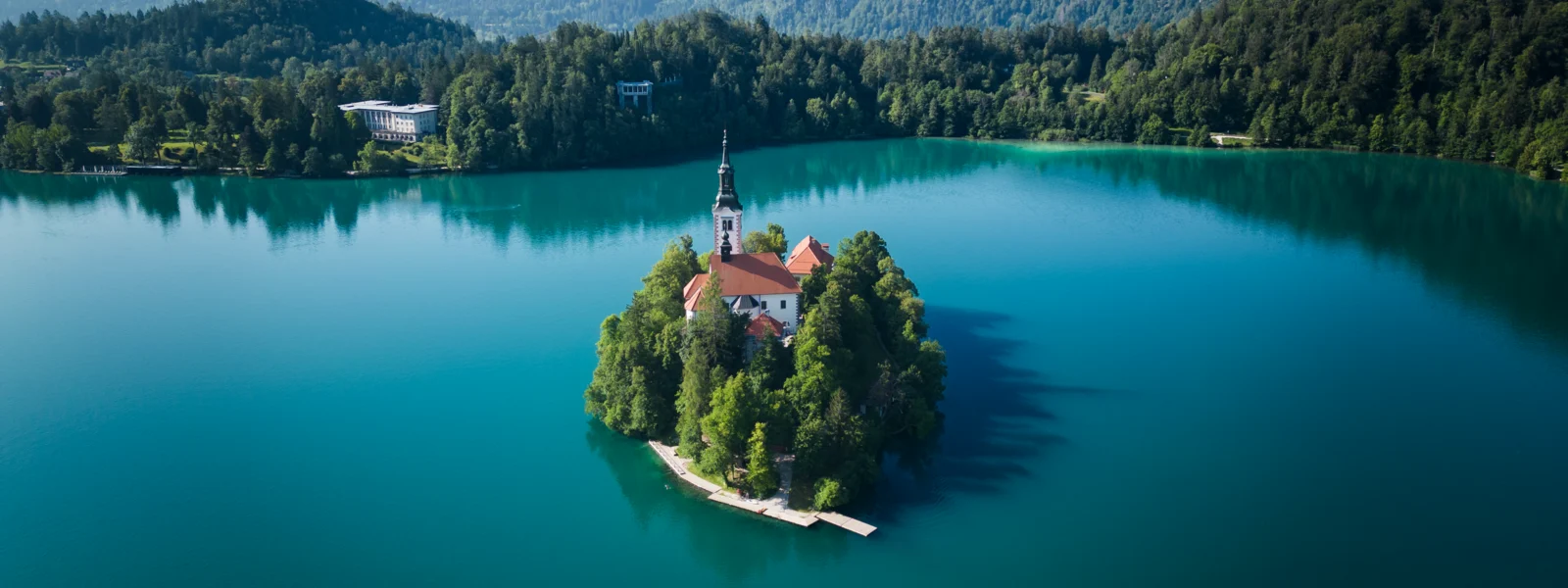
The two great lakes of the Julian Alps are among Slovenia's most photographed places, and both are well connected at their shores. Lake Bled, with its island church and clifftop castle, sits in a town with solid coverage, so you can navigate, book a boat to the island, and share photos without trouble. Lake Bohinj, larger, wilder, and quieter, is also covered around its main settlements, though the surrounding mountains mean signal can thin on the trails that climb from the water. Both make excellent bases for exploring the national park, and from either you can reach the high country quickly. The pattern holds throughout this region. The places people gather, the lakeshores, the villages, the resort bases, have signal, while the heights above them do not, so you stay connected at your base and prepare offline for the climbs.
The Soca valley and the high passes
The Soca valley, with its astonishing turquoise river, is one of the most beautiful drives in Europe, and the dramatic Vrsic pass that links it to the Bled side is a highlight in its own right. Coverage follows the valley floor and the road for much of the way, so you are connected in the towns of Bovec, Kobarid, and Tolmin and along the main route, but the high pass and the side gorges can drop signal. This is classic alpine territory where offline preparation pays off. Download the route, the maps, and any trail notes before you set out, and the occasional dead zone on a switchback or a high saddle becomes irrelevant. The valley is a magnet for outdoor activities, from rafting to hiking, and operators there are reachable by message even where a phone call might not connect, so plan your adventures from a covered spot and enjoy the wild stretches offline.
From the mountains to the sea in a day
The defining Slovenian experience is the sheer ease of moving from the Alps to the Adriatic, and your connectivity adapts as you go. Leaving the mountains, where you have leaned on offline maps and valley signal, you drop toward the coast and back into dense, reliable city style coverage at Koper, Izola, and Piran. The contrast is striking, from preparing for dead zones in the morning to streaming on the beach in the afternoon. A regional Europe eSIM is especially handy on this kind of day, because the coast sits minutes from the Italian border at Trieste and close to Croatia's Istria, and a single plan covers them all without interruption. Whether you finish the day with seafood in a Piran square or cross into Italy for an espresso, your data follows you seamlessly, which is exactly what makes a trip combining Slovenia's mountains and sea so rewarding to plan and to live.
Triglav National Park and serious hikes
Triglav National Park, encompassing Slovenia's highest peak and its most dramatic alpine scenery, is the place where offline preparation matters most, and it rewards a thoughtful approach to connectivity. The valley bases and trailheads generally have signal, but the serious hikes, up toward Triglav itself, along high ridges, and into remote valleys, will take you well beyond coverage for hours at a time. For these, download your route into your trail app, save offline maps of the whole area, and carry your accommodation and emergency details offline before you leave the valley. Tell someone your plans and expected return, as you would in any mountain environment. This is not a reason to avoid the high country, which is the very reason many people come to Slovenia, but a reason to prepare properly so that being offline is a planned and comfortable state rather than an anxious surprise. With the right preparation, you can disappear into some of Europe's finest mountain scenery for a day, knowing your phone holds everything you need even with no signal, and reconnect when you descend to the valley.
Coastal towns and crossing to Italy and Croatia
Slovenia's tiny coast packs a lot into a few kilometres, and its proximity to two borders shapes the connectivity choice for anyone exploring it. The Venetian influenced town of Piran, the working port of Koper, and the relaxed resort of Portoroz all enjoy dense, fast coverage, so the coastal portion of your trip is as connected as any city. The interesting part is how close everything else is. Trieste in Italy is a short drive from Koper, and Croatia's Istrian peninsula begins just to the south, both tempting additions to a coastal day. For anyone likely to cross either border, a regional Europe eSIM is the obvious choice, keeping you connected seamlessly as you move between three countries that here lie within an hour of one another. Without it, a single country Slovenian plan would simply stop working the moment you crossed into Italy or Croatia, leaving you stranded for data. Given how naturally a coastal visit here spills across borders, the regional plan turns what could be a connectivity headache into a complete non issue, letting the whole compact, international corner of the Adriatic open up to you on a single uninterrupted connection.
Connecting Slovenia's mountains and sea
To bring it all together, exploring Slovenia's Julian Alps and Adriatic coast is one of Europe's great compact adventures, and a little connectivity planning lets you enjoy it without a worry. The mountains, centred on Triglav National Park and the lakes of Bled and Bohinj and the Soca valley, are well covered on their floors and in their towns but demand offline preparation for the serious climbs, where terrain takes you beyond signal for hours. The coast, from Koper to Piran, matches the cities for dense, fast coverage, with the bonus that Italy and Croatia lie within an hour, making a regional Europe eSIM the natural choice for anyone likely to cross a border. The defining Slovenian pleasure is moving from alpine peaks to the Adriatic in a single day, and your connectivity adapts as you go, from offline maps and valley signal in the morning to streaming on the beach by afternoon. Prepare offline for the heights, lean on the strong coverage everywhere else, and consider a regional plan for the border hops, and the whole remarkable variety of this small country opens up to you on a connection you can trust, leaving you free to focus on the scenery rather than the signal.
Plans for Slovenia
Slovenia eSIM plans
Prices in USD. Instant QR activation. Pick your data, land connected.
FAQ
How much data and what kind of plan do travelers need in Slovenia?
A trip combining the Alps and the coast is light on data in absolute terms, because so much of your time is spent outdoors, navigating and taking photos rather than streaming. Offline maps cut the cellular load further. For a week split between the mountains and the sea, three to five gigabytes is comfortable for most travellers, with accommodation wifi covering the heavier tasks. A regional Europe eSIM is especially worth considering here, since the coast sits minutes from both Italy and Croatia and the temptation to cross a border is strong.
What should travelers prepare before entering low-coverage areas in Slovenia?
Before heading into the Alps, build the simple habit of downloading offline maps of the area and saving your route, accommodation, and key directions while you still have signal in the valley. If you are hiking in Triglav National Park or driving the dramatic Vrsic pass, download everything in advance. The valley floors will keep you connected most of the time, but the offline backup means a dead zone on a ridge or in a gorge never becomes a problem. A few minutes of preparation transforms the experience of exploring the high country.
What coverage and network performance should travelers expect in Slovenia?
The Julian Alps, centred on Triglav National Park, are spectacular and largely well covered on the valley floors and in the resort towns. Bled, Bohinj, Kranjska Gora, and the Soca valley settlements all have solid signal, so your base will be connected. The gaps appear when you climb, on hiking trails, high passes, and back country routes where terrain blocks the signal. This is normal for any mountain region. Treat the valleys as connected and the heights as offline, and prepare accordingly before you set out on any walk.
What should travelers know about lake bled and lake bohinj in Slovenia?
The two great lakes of the Julian Alps are among Slovenia's most photographed places, and both are well connected at their shores. Lake Bled, with its island church and clifftop castle, sits in a town with solid coverage, so you can navigate, book a boat to the island, and share photos without trouble. Lake Bohinj, larger, wilder, and quieter, is also covered around its main settlements, though the surrounding mountains mean signal can thin on the trails that climb from the water. Both make excellent bases for exploring the national park, and from either you can reach the high country quickly. The pattern holds throughout this region.